Monday, June 29, 2009

"I'll take Turkish Potpourri for $500, Alex."

There are a bunch of noteworthy things about my trip to Turkey that don't fit into any particular category such as Sightseeing, People, or Food. ("Wait--Food?" you ask. ...That's right, there's more! You still have yet to hear about the food or the wonders of Cappadocia. But I digress.) Thus, I've decided to put my miscellaneous experiences into the category of:

Turkish Potpourri


Rebecca Horts:

I arrived in Istanbul shortly after 11 pm. By the time I got through the line to purchase my entry visa, and then through the line for passport control, it was well after midnight. I'd pre-arranged an airport pickup with the hostel, so when I stepped through customs and into the arrivals hall, I spotted my cab driver waiting for me with a sign labeled "Rebecca Horts." Not only did it amuse me that I was one of the people on the signs, but the creative spelling of my name was pretty amusing as well. (Though not as amusing as this classic booking from my OZ 08 trip through Australia last year.)

The Call to Prayer:

I first heard a call to prayer on a fieldtrip to the Richmond Mosque in my 9th grade world history class. We'd spent a whole semester learning about Islam, and this was our practical application. I remember that the trip made such an impression on me at the time--as a 14-year-old WASP from the 'burbs I'd never had any interactions with Muslims--and for years afterwards I appreciated that trip and our Q&A session with the imam after the Friday prayer service for broadening my horizons beyond everyday Chesterfield County. That being said, I was 14 years old and had never heard a call to prayer. And I won't pretend that my first reaction wasn't to suppress a giggle at the weird foreign sounds of the chant. But fortunately I managed to stay composed, and by the end of the call to prayer I wondered how I could have even wanted to laugh.

The second time I heard a call to prayer was in Istanbul.

Just as the church bells in Austria chime at regular intervals 3-5 times a day (depending on the day), the call to prayer rings out through the city 5 times a day. Even my earplugs weren't enough to mute the 5 am call to prayer, a much earlier alarm than its 7 am churchbell counterpart in Austria. When it's time for a call to prayer in Istanbul, all the different mosques send out a live transmission on loudspeakers secured on the minarets, and pretty soon you're surrounded by a round of calls to prayer. At first it was a little strange, just because it is such a different noise than what I'm used to--it was a regular reminder that I was a guest in a country whose culture is far different from any other country I've experienced; however, gone was the 9th grade propensity to giggle. I came to enjoy the calls to prayer and found them melodic and interesting, especially when we found ourselves in a particularly interesting part of the city when it happened, like the video below.


The Turkish Flag Challenge:

It didn't take us long to realize that there is a Turkish flag from nearly every vantage point in Istanbul. It is omnipresent. (...And you thought Americans were patriotic...)

When we realized just how ubiquitous the flag really is, we decided to initiate a challenge: the Turkish Flag Challenge.

Participants: 2 or more players
Equipment: A Turkish flag and a buzzword
Preparation: As a group, determine a mutual buzzword (for example: "Strudel"). Any player may initiate the Turkish Flag Challenge at any time.
Rules: When out and about in Istanbul, any player can call out the buzzword (ex: "Strudel!") at any time. The other players must stop in their spot and search for a Turkish flag within eyesight. The first player to point out the Turkish flag wins that round.
Winners: There are only winners, never losers.


Türkçe konuşur musunuz? *

Before I left for Turkey, a few friends had given me some helpful phrases in Turkish, such as: "Hello;" "Thank you;" "How much?"; and "I want to get off the minibus!" But I always try to pick up as much of a foreign language as I can while I'm in the country, so I made it a point to constantly ask friends, the hostel proprietor, and pretty much anyone else I was dealing with how to say things in Turkish.

But it was hard, man. Turkish is tough. It was really difficult for me to distinguish the different sounds, let alone the different words. Once I had a better understanding of how to pronounce written Turkish, it made it a little easier to order things. And it was the little victories--the baby steps--that made it so rewarding. Sometimes it helped to use pneumonic devices; for example, the Turkish word for "thank you" is
Teşekkür ederim, which sounds very similar to "tea sugar dream." (N.b.: Similarly, some visitors in Graz have found the German word for "excuse me"--Entschuldigung--to sound like a mumbled "I'm chewing gum.")

First I ordered, "Three teas, please," at a teahouse when my companions had left the table. I was able to throw in the numbers 1-3 in any setting, actually...but mostly where drinks were involved. When haggling, I could even use a sad-looking, "No, too much." But my crowning moment in Turkish was after my oil massage in the Turkish baths: I was able to whip out a confident, "Thank you. Good. Super." ...I mean, what more can you really say about a good massage? Finally, I went to meet a friend in Istanbul on my last afternoon in town. I was alone and took the tram to her stop. When I got off, I felt a tap on the shoulder, and I turned around to see a Turkish bottle blond who immediately said, "Pardon..." and then a bunch of Turkish I didn't understand. This was it--this was my moment. My moment to use a real sentence and say, "Sorry, I don't understand," or "Sorry, I don't speak Turkish." But when the words came out, it was a very English sentence and I'd lost my chance to use a real Turkish sentence in a real-life situation forever. But I was flattered by being taken for Turkish.

*Click on the link to hear the phrase "Do you speak Turkish?" in Turkish.

I Scream, You Scream:

We all scream for Dondurma!

I am a huge fan of ice cream. Forget chocolate, just tell me where the ice cream is. In Rome, I had the gelato at least once a day. In Graz, I can hardly get out of town without visiting one of the ice cream shops placed tantilizingly on every street worth walking on. And in Turkey...well they have ice cream too. And I couldn't wait to get my hands on it.

I first became suspicious of the Turkish ice cream when I went to give my order and the ice cream man pulled out a long-handled metal paddle. Now that's odd. And then when he put my two scoops on the cone...something wasn't quite right. They seemed to glisten unnaturally, and although mine was the first to be served, it hadn't started dripping down the sides of the cone by the time my two friends got theirs. And then we all tasted it.

It was cold. Now's that's familiar, I'm feeling it. But wait! It's...it's...chewy?! Yes, Turkish ice cream is downright chewy! It's got the consistency of a marshmallow turned into ice cream, which is an odd sensation indeed. The Turkish consider this type of ice cream "normal;"our stuff--like gelato, soft serve, and what you and I consider normal ice cream--isn't real ice cream from the Turkish perpective. And after more investigation, I was happy to find out that my first impressions of this Turkish ice cream were right on: the special features about dondurma are its texture (chewy!) and its resistance to melting. Very weird, but very cool. If you ever find yourself in Turkey, this experience should not be missed.


Squatty Potties:

I am so glad I was forewarned about the Turkish toilets. So glad.

As I mentioned before, being in a new country with a new culture brings new experiences. Such as squatty potties. Those of you who have spent time in Asia are probably laughing at me right now, and rightly so. But I am a spoiled, modern Westerner who values her clean, porcelain toilet bowls very much.

I was only able to avoid the inevitable for one day. Then, on my second day in Istanbul, I just had to go. The good news is, there's any number of public restrooms all throughout the city. In fact, just find a mosque (which is pretty much at every turn) and you've found yourself a restroom too. The bad news is, they are almost all squatty potties. Oh, and the other bad news is, you have to pay to use them.

The funny thing is, in places like Vienna, I will rather hold it in that pay for a public restroom...either that, or I spend way too much time searching for the nearest McDonald's, which is universally gratis. However, in Turkey one has no such luck. Sometimes you luck out when paying the bathroom attendant the 50 kuruş to 1 lira (30
¢ - 60¢) "entrance fee" and you'll also get some toilet paper as part of the service. (Although I use the term toilet paper loosely: this could mean anything from a napkin to a couple sheets of actual toilet paper.) This is why the well-informed traveller carries travel tissues at all times. The actual device one uses to complete one's business is basically a glorified hole in the ground. A porcelain hole with ridges on either side to provide traction for your shoes, but a hole nonetheless. In the corner of your stall is a waste bin to throw in the used paper/napkin/whatever-resourceful-thing-you-find-in-your-purse-to-do-the-job, and in the other corner is a spigot and a small plastic container, for what I can only assume is rinsing off a sticky load. Ironically, although you hardly ever find toilet paper in a public restroom, I found that--without fail--there was always soap.

The first time I had to use one of these, I was terrified. I am not a go-in-the-woods kind of gal. Women just aren't designed for this kind of maneuver, and I think I was jusifiably concerned over the outcome. But let me tell you--I nailed it. A perfect 10 on the first try. And by the end of the trip, it was no biggie. So...anyone ready for a long hiking trip in the woods?


Street dogs--and cats:

Lots of stray cats and dogs roam the streets of Istanbul. I was quite surprised by the number of stray cats--something I've not seen in other countries--and pretty impressed at the docile and non-agressive nature of the dogs. They just kind of went around and did their own thing. (Compared to the Romanian strays, the Turkish variety belong in a petting zoo.)

This cat had somehow turned a bluish-green...pretty funny, actually.


Women and the Workplace:

It took me a while to notice it. Almost a week, actually. But then it occurred to me: you don't see women working in Turkey. Not in the shops, the markets, the restaurants, or the info offices for the tourists. In fact, the entire time I was there, I only saw three women at work: one heavily-armed policewoman for Obama's visit in Istanbul, one reporter for said Head of State's visit, and one shop assistant in Cappadocia. That said, it should also be noted that people tend to work really long hours. The hostel proprietor was basically working 24/7, the guy behind the counter of the coffee shop at 7 am was still there at 9 pm, and the shopkeepers seemed to work at their shops every single day.

It didn't take this reporter long to spot the foreigners and ask for an interview on the day of Obama's visit.


...Ok, still with me? Good. I think that's enough grab-bag for today. Next up: more potpourri and then--oh man, my stomach is growling already--the food!

Wednesday, June 24, 2009

Someone Worth Meeting

One of the most interesting things about all of my travels these past months has been meeting some of the most interesting people along the way. Aside from seeing new places and experiencing new cultures, there's really something to be said for opening up a little and interacting with those around you. People have the most fascinating stories.

Sometimes you are lucky enough to live in a place like New York City where you bump into all sorts of intriguing people all the time. One of my favorite things about living in New York was learning what people did for a living--often you'd meet someone with a job you never could have even dreamed up. Not to mention that, as a city full of domestic and international transplants, everyone has a personal how-I-got-here, how-I-came-here, or who-I-was-before story.

I find that travelling opens you up to the same kind of thing, but on a broader basis. Over the past several months I've met quite a few people whose stories just floor me. Some of them have had life experiences I can't even begin to imagine. Some of them were kind people who've helped me along the way. Some of them are so inspirational that I want to fictionalize them into my next novel.

So today's next installment of the Turkey sequence is about the people we met along the way. Each interesting in their own way, and each somehow moving us along. (n.b.: Nor is this the last installment of people I've met in my travels. A few more notables from more recent travels will appear in a future post.)

The Cyclist

Our first day in the hostel, I started a conversation with a quiet looking man in the common room just as we were about to head off to bed. It was immediately apparent from the lilt in his voice that he was an Irishman passing through Istanbul. When we asked the usual questions about where he was from and what he was doing, we got the most unusual answer: he was cycling around the world. Okay, I'm just going to let that sink in a bit...

Yes, he was cycling around the world. Very few people have done such a thing, but his goal is to cross the globe on bicyle in the next two years. As we met him, he'd just cycled his way down from Ireland and through Europe into Turkey, and he was currently planning his way through Turkey into Iran and further on to Uzbekistan. In that area of the world he had to apply for entry and exit visas and time his arrivals and departures exactly, which doesn't leave much room for unplanned obstacles underway. Eventually he'll make it through all those countries ending with -stan and all the way across China before hitting an ocean and having to hop over to the next continent. As we spoke with him, he was just updating his blog.

President Obama

We also happened to time our trip to Turkey quite well with Obama's own visit on the last leg of his G-20 talks in Europe. He was pretty much omnipresent for a few days, from billboards to news shows, to the word on the street. Having wrapped up most of his business in Ankara, his trip to Istanbul was to include some sightseeing downtown at some of the major sites, such as the Hagia Sophia, the Blue Mosque, and a few other places in the historic district of Sultanahmet. Consequently, the city decided not just to shut down these sites, but pretty much the whole of Sultanahmet itself--including public transportation in and out. Nearby businesses, schools, and even the university closed for the day, and the streets were lined with a large and heavily-armed police force.


In response to all this hubub, we encountered a demonstration on the pedestrian shopping street of Istiklal, and as my travel buddy went closer to film the protest, we--clearly foreigners--were approached by reporters. Our Turkish friend was interviewed first, but we were told to stay put as soon as our nationality became known, as the reporter really wanted to get the American opinion on the matter. Many of the Turkish people I'd talked to felt pretty good about President Obama in general and his visit to Turkey in particular, but the country was still a little wary in general of Obama for referring to the Turkish killing of Armenians in WWI as "genocide," for the U.S.' tendency to side with Israel, and for our involvement in Iraq/Afghanistan (Iraq being one of Turkey's border countries).

When it was my turn to be interviewed, the reporter asked me a series of questions about how long I'd been in Istanbul, where I'm from and what I do there, what I thought about the protests, and how I felt as an American in Turkey since politics there have become rather anti-American. I did my best to answer her questions, but it really didn't matter...when the article came out, they had strung all of my answers together and printed them out of context, such that I came off sounding like an ignorant American and where I was quoted saying things I'd never actually said.


The next day, we made a conscious decision to avoid the Obama craziness and go to the Asian side of the city. We left our Sultanahmet hostel as they were preparing to close off the streets, passing a massive police force and throngs of reporters setting up for the visit. As it happened, the friend I was travelling with got interviewed by the local news station, and we didn't actually make it out of the European side of the city before Obama came through: we ended up seeing his motorcade around noon as it raced into Sultanahmet and again later that afternoon from the ferry as it crossed over the bridge we had just passed under.

So although we didn't actually see President Obama personally, we saw his motorcade. This was exciting enough for me and stirred up a surprising amount of patriotism, as it was the first time I have acutally been in the same country as Obama since he's been president.

Obama's motorcade: He could have been in this very heavily-protected SUV!!


A Friend of a Friend

One of the best things about travel is of course meeting up with your friends from around the world, right? Although I didn't personally have any friends in Turkey at the time of my visit, I knew several people who'd either visited or lived there before I went. One friend got me in contact with one of her Turkish friends in Istanbul, and this friend turned out to be such a gem to our trip. Not only did she agree to meet us and show us around, but she took us to some of the local places, introduced us to some of the sights and the food, and generously donated her time, energy, food, money, and language as she shared the city with us. The more locals we met, the more really great hospitality and generosity we experienced--it seemed quite a welcoming culture, and we were privileged to be the recipients. We came away from it having taken our friend's friends for our own.


The Proprietor

The proprietor of the hostel where we stayed was an incredible man. I arrived in Istanbul after midnight and took a pre-arranged taxi pick-up to the hostel. From the moment I arrived, the proprietor greeted me warmly, and that was just the beginning.

Ali was all-knowing and could gladly and willingly answer any question about Istanbul, Turkey, the Turkish language, or pretty much anything else that we posed to him. And we asked him a lot of questions during our stay. He was helpful and funny and had the incredible ability to deal with every type of person who walked in the door.

I've never met a better person than Ali when it comes to sizing someone up and dealing with them accordingly. As soon as he met a new visitor to the hostel, he seemed to know exactly what kind of person they were and exactly how to deal with them. His skills would be the utter envy of customer service representatives everywhere, or anyone who deals with the public for that matter. He first impressed me when, after our first night in the hostel, a Finnish girl in the room next door complained about our "loud" talking the following morning on her way out to the airport. As Ali related this incident to us at breakfast, I was expecting a reprimand and an appeal to be quieter; instead he went on to tell us how he'd defended us to the Finnish girl, explaining to her that we were just seeing each other for the first time in years and were probably catching up late into the night. From this moment on, Ali won me over, and I watched in awe as he put the rowdy British boys in their places with a genious and effective combination of humor and shame, dealt with the highly irritable man who kept complaining about how he couldn't trust the Turkish, and every other sort of person to cross his path. By the time we left for Cappadocia, he said goodbye with a tight hug and told us quite sincerely how he'd enjoyed having us there and would miss our smiles when we were gone.

Not only could Ali deal with any kind of person in exactly the way suitable to their type, but he also had the gift of making someone feel welcome and comfortable. For me, this was in very tangible ways. When I arrived back in Istanbul from Cappadocia--alone--before 8 am on a Monday morning after a sleepless 11-hour overnight bus ride, I had to ring the bell twice before he answered the door. He'd been sleeping at the office since they were short-staffed and I'd awaken him from only two hours of sleep that night. I assured him that I was in the same boat, as I'd not been able to sleep on the night bus, and announced my intention to take a nap as soon as my room was ready; however, the hostel was full and he told me I'd have to wait until after 11 am until the bed was emptied and made ready. As I settled down in his office at the public Internet/computers to wait it out, he did the unthinkable: he offered me a nap on his couch, promising to shut the door and keep guests out and only to come in himself to answer the phone. I've never been more grateful for anything in my life than I was in that moment.

When I left Turkey, it was another genuine goodbye and a sincere request to stay in touch...and we've both since followed through.


The Pigeon Guy

In Cappadocia, we visited the Göreme Open Air Museum, a complex of cave dwellings and cave churches typical of the area. Up near one of the caves, there was a flock of pigeons hanging out near a ledge, and my travel buddy went over to feed the birds some of her leftover bread from breakfast. As she was doing so, a man in the Open Air Museum uniform came out of the nearest cave entrance and told her to stop and wait there. We both thought she was in trouble, but the man returned momentarily with a handful of birdseed which he deposited into her palm and then showed her how to feed the birds. I was watching from a short distance with great amusement when the man announced that these pigeons were special pigeons. Yes, Cappadocian pigeons are no ordinary pigeons--they can roll. At first, I didn't understand him. But he made a rolling motion with his hands and repeated again that these pigeons could roll. We clearly didn't understand what he was telling us, because he then stood and told us to watch. Then, very slowly, he approached the pigeons and herded them off the ledge. As they took flight, they rose vertically, their wings making an unusually loud clapping noise; then, one of the pigeons flipped! Then another! As these pigeons rose vertically in the air, they did backflips while in flight! We were so amused by these birds that I think we in turn amused the museum employee, and he invited us into his office--the nearest cave--for a cup of tea. Tea is a very central part of Turkish hospitality, so we joined him and his colleague in the cave for tea and conversation. The man who invited us in spoke some English, but his coworker spoke only a few words here and there. Somehow we carried on a very basic conversation with a lot of repetition and gesturing and the few Turkish words we knew, but ultimately we all made ourselves understood. We stayed for two cups of Turkish tea (which I'll describe at a later time) and then left to go visit the rest of the museum. But this was the first time that someone had invited us in for tea for no reason at all--not because they knew us and not because they were trying to sell us something, but simply to be nice, to extend some hospitality, and for the sake of our company.


And finally, stay tuned...

Next up: Miscellaneous things about Turkey you've probably never considered. Oh boy!

A Letter from the Editor

Dear Readers,

I am ashamed. I am a terrible blogger, or rather, blogger correspondent. I have so many interesting things to tell you but I've let the blog fall silent for way too long.

By now I should have finished telling you all about Turkey. After that, there was a pretty nifty trip to England and Wales I could have caught you up on. Not to mention the most recent developments with my immediate plans for the summer, involving Serbia, Malta and more of Austria. I could have already reflected on the end of my two years as a TA in Austria. I could have reflected on the past two years, period. I could tell you why Graz is wonderful in the summertime, and I could tell you how--after a four-year absence from the sport--I've just picked up biking again. Heck, I could even tell you about the book club I've helped establish and the writing group I've joined.

All of this, I'd tell you, has been put by the wayside in favor of finishing my NaNoWriMo novel from November. I could feed you all sorts of excuses about how I'm spending my current stage of unemployment trying to finish the first draft and how novel-writing doesn't leave much time for blog-writing.

But I won't. It's just too much to tell you. It's too daunting.

Instead I'll just promise you that you will hear from me. Soon, even. I'm going to get right on it. Because I actually thrive on your comments. Knowing that you read my posts and actually tend to comment on them makes me feel like we're actually keeping in touch. And that's important. I won't kid you--after two years here I still really enjoy it, but I miss you guys a lot. So I'm going to make an attempt at keeping up this one-sided conversation more frequently.

My apologies, and see you on another update soon.

Yours truly,
Rebecca

Saturday, May 23, 2009

How to be a Shameless Tourist in Istanbul

It's been quite a while since I've written anything, but I promised there would be more on Turkey. So here's the next installment...finally!

Tourist Attractions in Istanbul

Although we had many insider tips, we still ended up seeing all of the typical sights in Istanbul (...I mean, how can you not?...), plus a few more.

The Hagia Sophia, Blue Mosque, Basilica Cisterns, Topkapi Palace and several other attractions are all located in the old historical Sultanahmet district of Istanbul. It's pretty much the starting point for any basic sightseeing, and many of the city's reasonably-priced hostels and not-so-reasonably-priced hotels are located here. Our hostel was a mere 4-minute walk from the back of Hagia Sophia and Topkapi Palace, which also meant that everything to see here was within walking distance.


Our first stop in Istanbul was the Hagia Sophia. This was a structure I vaguely remembered from 9th grade history class, but whose medalions and soaring architecture had stuck in my head since I was forced to memorize about eight different images of it in Art History 101. Orginally constructed as a cathedral under Emperor Justinian in 532-537 AD, it was the epitome of Byzantine architecture for...well...let's just say, for a heck of a long time. It also remained the largest cathedral in the world for a whopping 1000 years -- that is, until 1453, when Mehmed II conquered Constantinople. This marked the end of the Byzantine Empire and the begin of the Ottoman Empire, and our good buddy Mehmed II converted the Hagia Sophia into a mosque. But you can't get rid of an epitome of architecture so easily, no sir! True to form, the Hagia Sophia continued to be a model for later Ottoman mosques, including the Blue Mosque, which you'll find right across the street.

Thus, it was a natural second stop to visit the Blue Mosque, or the Sultan Ahmed Mosque, directly across the street from the Hagia Sophia and separated from it by a well-kept garden. The Blue Mosque was built a bit after Mehmed II's time, between 1609 and 1616 by none other than one Sultan Ahmed I. The Blue Mosque is one of the largest mosques (and it is also the national mosque of Turkey), being so named for the heaps of blue tiles in the interior. There are something like 20,000 handmade ceramic tiles on the inside, and like the Hagia Sophia, one gets the impression of soaring gradeur when standing on the inside and looking up. The Blue Mosque clearly draws architectural inspiration from its predecessor, the Hagia Sophia, and thus pulls off a grand marriage of Byzantine and Ottoman architecture. (And yes, I said a "grand marriage"!) Visitors to the mosque -- or any mosque -- must remove their shoes, and women must cover their heads. Since it was the first mosque we visited, I was particularly struck by the non-stop blend of patterns, from the carpet to the tiles to the ceiling decorations; it was a beautiful, busy aesthetic and was something I kept marveling at in every other mosque we visited. Unlike the Hagia Sophia, which is now a museum, the Blue Mosque is still a functioning mosque.


To any visitor to Istanbul, I would also highly recommend Topkapi Palace. The first day we visited Topkapi, we didn't allow ourselves enough time to see it all, but perhaps the fact that we were willing to spend the 20 lira entrance fee to come back again can testify to its rightful place as a must-see attraction in Istanbul. Visitors pay outside and enter the palace grounds through a gate that is extremely reminiscent of the blue-and-white animated palace at the into to any Disney movie, so you already know that you're off to a good start. Inside is the palace complex, the main residence of the Ottoman sultans from 1465 (when Sultan Ahmed II commissioned himself a palace as the first Ottoman emperor) to 1853 (when Sultan Abdul Mecid I moved the official residence to Istanbul's other palace -- the newer, western-style Dolmabahce Palace), the modern-day visitor can see any number of imperial exhibitions. It's a good idea to check the display board by the ticket office to see which exhibitions are currently closed (unfortunately the kitchen was closed for our visit) or open. It's a full day's work to see the treasury, the stables, the apartments and chambers, and -- perhaps most intriguingly -- the imperial Harem. Although you'll pay a second, nearly equal admission price to see the Harem, it is well worth it. Not only can you learn the history of the harem (not at all glamorous), but you can see some of the most finely ornamented chambers in the palace. Topkapi is probably an all day affair, but it's a sight I wouldn't leave out.

All of that opulence made us feel rich as sultans, so what better natural outlet for our bulging purses than a visit to The Grand Bazaar or the Spice Bazaar (also call the Egyptian Bazaar)! The Grand Bazaar was nothing like the large flea market I had somehow envisioned -- rather, it's one of the largest covered markets in the world. There are over 1000 shops stuffed into countless corridors, some of which (to my surprise) even have glass-windowed storefronts. The merchants at the bazaars will call out to you as you pass to buy their jewelry, scarves, carpets, pottery and spices. Of course you'd be a fool to pay full price for anything, but there's only so much haggling you can get away with as a tourist.

Istanbul has the unique distinction of being a city divided between two continents. All of the tourist attractions are on the European side, but the Asian side offers a more authentic look at the city free from the throngs of travelers. The Bosphorus acts as the straight between Thrace (the European part of Turkey/Istanbul) and Anatolia (the Asian part), connecting the Black Sea in the north to the Sea of Marmara in the south (which, in turn, connects to the Aegean and by extension to the Mediterranean). The ferry runs back and forth and up and down the river, so we took it over to Üsküdar for a quick visit to Asia and then further on up to Eyüp (on the European side again) where we saw some more out-of-the-way sights.


If you find yourself back near the Hagia Sophia/Blue Mosque area with nothing to do, you may want to look someplace you'd least expect for a great attraction: underground at the Basilica Cisterns. You'll see the ticket office at road level, then as you decend into the cisterns you'll find another of Justinian's great accomplishments of the 6th century: a massive cathedral-sized cistern capable of holding 2,800,000 cubic feet of water. A boardwalk leads the visitor through the arcaded structure, and that same feeling of size and grandeur returns.


One of our accidental discoveries was the old City Wall. We were actually trying to go to a museum that happened to be closed (on a Wednesday?!) and ended up exploring the area instead. The old city wall still runs around the city in certain places, and remains open to the public. Although it would be a major liability in America, in Istanbul you can scramble up the steep and narrow ziggurat-like steps of the wall to the lookout station. This gave us a great and FREE view of the city, and eliminated the need to go up into the more touristy Galata Tower.


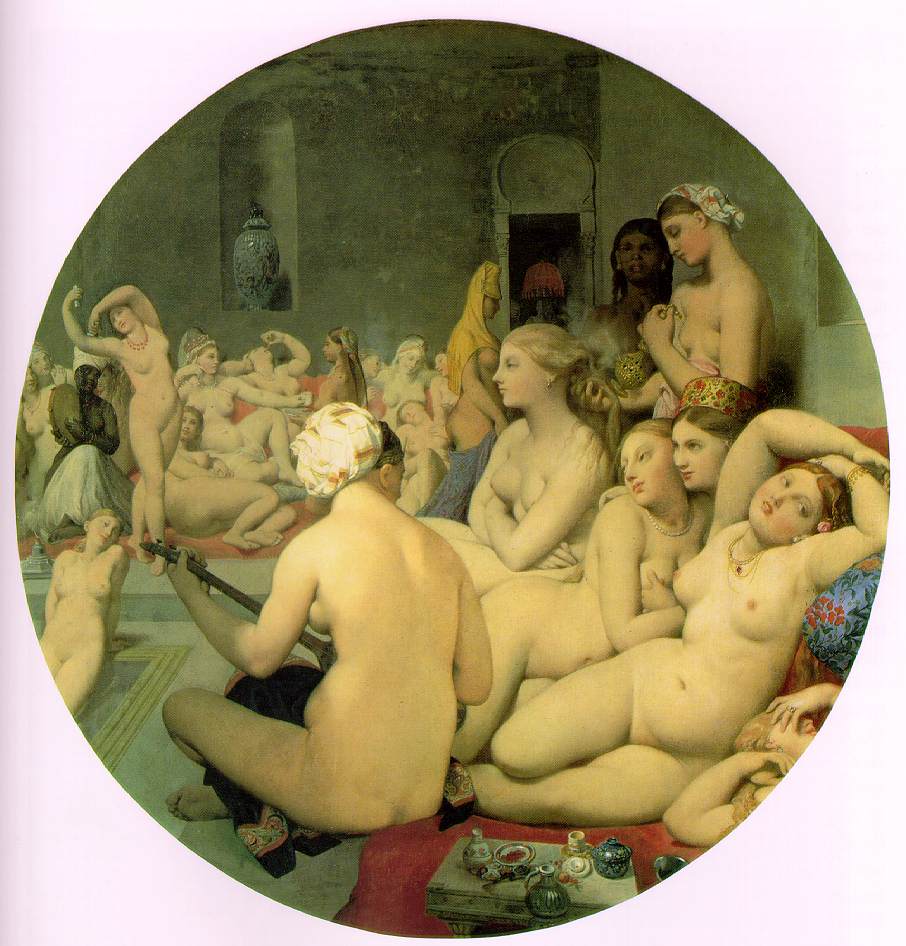
After all of this sightseeing, you'll want to wash the grit of the city off with a nice deep clean. Fortunately, Istanbul offers any number of Turkish baths designed with this very purpose in mind. We visited the Cemberlitas baths, the oldest, most touristy, and therefore most expensive baths in the city. All that being said, it was well worth it, and I wouldn't have done it any other way. Far from the classical pipe dream that Ingres depicted of the Turkish baths, the Cemberlitas was built in 1584 by the sultan's wife, for the purpose of bringing in a little extra revenue. Today visitors can come and experience something most adults haven't experienced in decades -- being bathed by someone else. Separated into men's and women's chambers, most guests enter nude or mostly nude into the large circular sauna room. In the middle of the room centered under a dome is a heated marble slab where you can stretch out and wait until it is your turn to be bathed. We got a package for a "bath," soap massage, and an oil massage...and it was well worth the splurge! I can't remember the last time I felt such a deep clean, and the best part of it is that you can hang out in the sauna or in the little pools surrounding the sauna as long as you like. But make sure you plan your trip to the baths for the end of the day -- it will take every last ounce of remaining energy out of you, and they only thing you'll be capable of doing afterwards is eating a big greasy kebab.


...So now that you've had a taste of the major sights in Istanbul, you can stay tuned for a taste of another kind...next update will be on Turkish food. Yummy!

Thursday, April 30, 2009

Going East


The second semester of school is by far the best in Austria. There are so many holidays and school breaks that it seems we are hardly ever in school. Even as I now write, I am enjoying a very nice 5-day weekend in Graz. (N.b.: Today, May 1, is Tag der Arbeit, or the Austrian Labor Day. No school!)

Since I take every opportunity I can get to travel, I decided to go to Turkey for my Easter break. A friend of mine from New York was coming to visit, and so we decided to meet in Istanbul and then travel on to Cappadocia. We were in Turkey together for a week and a half, but it only took me several days to realize that Istanbul was my new favorite European city and that I loved Turkey.

I shouldn't tell you all about my trip because it would be another novella. So instead I've decided to cover the trip over several posts (like my farm experience last summer), highlighting just certain aspects of our travels and our experiences. I'll treat the trip topically, and if you want to know more, please just email me and I'd be happy to bombard you with all of the minute details you can handle!

Let's start at the very beginning. A very good place to start.

Why Turkey? The reason is quite simple, really: it's cheaper than the rest of Europe and, from what we'd heard, very interesting. One of our main considerations when planning where to travel was the cost. We considered places like Poland and other Eastern Europe destinations, but I'd already heard a bit about Turkey from other friends who had been there and thought it would be great to experience a completely different, non-Western travel destination for once. Until now, I'd only ever traveled in Europe and Australia, and never in a non-Western, non-(traditionally-)Christian culture. Last year I'd even made a list of places I'd like to visit while I'm still in Europe, and Turkey still hadn't been checked off. My travel buddy immediately agreed, and we started researching our trip.

How does a self-professed "anti-planner" plan a trip to a destination you should really know a bit about before you go?

I hate planning. Anything. I hate planning parties, I hate planning events, and I even hate planning trips. My travel M.O. is to arrive on the scene and then check it out from there. I might read up a bit before I go so that I know what I should see when I get there, but I rarely have an itinerary until I'm on the scene. But Turkey, being so culturally different from any place I'd visited before, was worth a little travel prep.

My travel buddy and I decided to research Istanbul and Cappadocia on our own and then come together with our combined knowledge and plan the trip from there. So I spent a couple days on the internet, looking up articles and such, but this wasn't really the part that interested me. The part that interested me was the suggestions, tips, and advice I solicited from several of my friends who had either lived in or traveled to Turkey.

I got in touch with about 5 different friends who had been to Turkey for various lengths of time and collected their advice. I got tips on what to see, what to eat, how to get around, and--most interestingly--how to act while in Turkey. So for today's excerpt of my Turkish experience, I'll start with one of the most interesting bundles of information I got before the trip:


The Do's and Don't's of Traveling in Turkey and How I Followed Them...or Didn't!

1. You shouldn't make eye contact or chat with men as you're walking down the street, on public transportation, etc., as this can be seen as a come on.
Um, as we learned, pretty much *everything* in Turkey can be seen as a come on! But putting that aside, I have to admit that this piece of advice was pretty hard to follow. You don't realize just how much eye contact you make with people as an American until you're deliberately trying not to make eye contact. I have certainly toned down the eye contact since living in Austria, since people don't really do that here either, but in Turkey it was so much more difficult! Especially because people watching in Turkey was so much more interesting, and it's hard to look at someone without really looking at them. I did notice that any accidental eye contact with men was immediately returned with a smile or a wink or a pick-up line, rather than a simple break in eye contact like here. It wasn't until my last day in Istanbul when I was traveling by myself before going back to Austria that I really mastered this. I put on my city face and was finally able to walk the streets undisturbed by looking like I knew exactly where I was going and and mentally blurring out the faces of any men I passed. But getting to this point was hard work.
It should also be noted that we were two
obviously non-Turkish girls walking around (one Caucasian and one Asian) and so that's bound to draw attention anyway. But we never felt really uncomfortable, and the attention we got didn't really seem like more than we'd get in other large cities.

2. It's not a good idea to speak English loudly or laugh in public, as this draws a lot of attention.
Me, not laugh in public? Yes, another challenge! There were enough tourists in Istanbul and Cappadocia that we didn't have to draw any extra attention to ourselves. And as an American living in Austria, I've already taught myself how to be quiet in public so as to blend in and not communicate "I am supporting the stereotype that American tourists are loud [and therefore obnoxious]" to those around me. But no matter how loudly or softly we spoke, we also noticed that the Turkish men had the uncanny ability to pick up on any phrase we uttered in passing and turn it into a pick-up line. ("Oh, hold on a sec--I dropped something." "Hello! Hello, lady! You dropped my heart!" Or: "Those British guys in the hostel were sooo loud, all night long!" "[singing] Youuu. Shook me alll night looong!") Finally, we decided it would make a good game to say something outrageous and see how our admirers could work with it. Best comeback gets a prize. ("And then my finger fell off!"...they could totally work with that material!)

3. Don't go outside with wet hair.
Some of you may recall my early posts about my arrival in Austria and some of the cultural differences I mentioned...including not to go outside with wet hair! Apparently it's the same thing in Turkey. Unfortunately, I don't have a travel hairdryer, so this meant that I could try my hardest to towel dry my hair but that ultimately I was, indeed, breaking this rule and going out with wet hair. As far as I could tell, there weren't any negative consequences. However, once we were walking down the street when my hair was completely dry, and a man called from a storefront, "How were the Turkish baths?" My travel buddy turned to me and asked, "How did he know we went to the Turkish baths last night?!" And as far as we could figure, it was my hair gel giving me the "wet hair" look. Oops.

4. Don't wear anything tight or low-cut, don't wear shorts or skirts above the knee, and don't wear sleeveless tops. It's also best to wear pants or long shirts that disguise/cover your butt.
One of my biggest questions before packing for Turkey was how I should dress. Although 99.8% of Turkish people are Muslim, it is a secular country (where, incidentally, headscarves are not allowed at universities or some government buildings) and you'll see the Turkish women wearing everything from conservative Islamic dress to far-from-conservative "Western" dress. As a foreigner though, it's best to be sensitive to the culture and dress modestly. The weather was nice and cool the whole time we were there, so we were able to dress in layers. Although none of my pants hid the face that I am a woman and therefore have certain curves, I didn't feel like that was ever a problem where I was. As far as we could tell, we never got oggled, and anything worth staring at was always covered. Fortunately we weren't there in the hot summer months when covering up more may have been somewhat hot.

5. Don't take layers of clothes off in public.
The most I took off in public was a jacket, so this is finally one rule we were able to keep!

6. Don't chew gum in public (especially blowing bubbles).
I forgot to ask why this piece of advice was here, but--like most of the others--we broke this one too. It was only after we were walking down the street chewing gum that I realized we were not supposed to do exactly that. And my friend had a habit of blowing bubbles. Oops.

7. If someone (especially a man) brings up the topic of U.S. foreign policy or politics in general, it's a good idea to avoid an inevitably heated discussion and politely change the topic.
Since our visit coincided with President Obama's visit to Turkey, this piece of advice was impossible to keep. Not only were both of us interviewed by the press (me for the English-language newspaper and my friend for the local news) about his visit to Turkey, but shopkeepers and hostel employees sometimes wanted to discuss Obama and/or U.S. foreign policy. I found that, for the most part, this was absolutely alright. One shopkeeper in Cappadocia even praised Obama and his politics (saying, sensitively, that he wouldn't even bother to address what things were like a mere 100 days ago with Bush), and told me that most Turkish people appreciated his visit. I only had one Turkish man tell me how bad U.S. foreign policy is, but I was just a bystander in the conversation, and he kept apologizing, saying, "I know where you're from. I'm sorry. But...."


8. Don't agree to pay full price for anything in the bazaars.
I'm sure we got ripped off enough as it was, but we were successfully able to negociate prices, usually to about 60% or so of the asking price. Which, for tourists, I've been told is reasonable. When we had the luxury of having Turkish friends with us, they did the haggling for us and we were able to buy our goods with much more confidence that we weren't getting horrendously ripped off!


...So, suffice to say that we broke plenty of rules and, at some point or other, went against pretty much most of the advice that was given to us. Fortunately we didn't have any problems...and now we know better for next time, right?

Wednesday, April 1, 2009

Home Sweet Socialized Home

I've not had much luck this year when it comes to maintaining my health after a big trip. I got sick after going to Berlin and I got sick after going to Australia...and I hope it stops there! But when I realized that I didn't just have to suffer through my illness--that I could go to the doctor so easily and at no cost to me--I decided that I better take advantage of it while I can. I've already seen several doctors and booked all the preventative appointments I need while I still have my amazing Austrian insurance. And as I was thinking about how wonderful this all is, it occurred to me that I should share with you the wonders of living in a socialized country.

Taxes in Austria
are only slightly more than in the U.S., yet their social security provides so much more. Basically, I can feel completely taken care of in Austria.

Since I'm employed by the regional school board, I get all of the same benefits as the Austrian teachers. This means that my health insurance is also provided by the government, through my employer. (In Austria, if you are self-employed or unemployed, you will need to provide your own health insurance; however, the rate is based on your income and there is government assistance for those who couldn't otherwise afford it.) At the beginning of my stay, I was provided with my e-card, which is an amazing handy-dandy credit card-sized proof of insurance and social security. The e-card has all of my insurance information stored on it and serves as an electronic signature, as well as a document of my medical records.

I can choose to see any doctor who accepts this national insurance, which is pretty much most of them. (There are also private doctors you can pay extra to see, but that is unnecessary.) The Austrian doctor's offices are much more relaxed than the American ones, with more (although sometimes unusual) office hours and a generous walk-in policy. The first time I went to the doctor, I simply showed up at the door and requested to see the doctor. There were not dozens of pages of medical history to fill out or a stack of forms to sort through; rather, I simply handed the receptionist my e-card and gave her my contact details, and a half an hour later I was called in to see the doctor. It was remarkably easy and astoundingly accessible.

A visit to the doctor, however, is not without it's fair share of Austrian formality. When entering the doctor's office you first must go through the waiting room, where it is customary to greet everyone as you enter. The receptionist is in another room behind a closed door, so then you must ask if anyone is already in there. If so, you wait there (not knowing in which order you are being seen) until it somehow becomes clear that it's your turn to enter. After giving the receptionist your e-card and telling her the reason for your visit, you go back into the waiting room and wait for your name to be called. Upon leaving, you once again wish everyone in the waiting room farewell.

The doctor's offices that I've been to are entirely unassuming, and they are often two or three rooms in an apartment building where only the one doctor has set up an office; the doctors I've seen are congenial and casual, often wearing jeans under their white coats. There's no changing into hospital gowns, and there's very little of an examination for any non-pertinent things. In my experience, the doctors are quick to give you a prescription and will simply give you a referral upon request...even the receptionist is authorized to give you a referral--so you can see basically whatever kind of doctor you want, whenever you want. The visit is free, with no co-pay required. The prescriptions can be filled at the pharmacy (where you have to get anything from ibuprofen to cough syrup to actual prescription-strength drugs), and the medicines are often quite cheap. As for more serious issues, hospital stays and treatments as well as ambulance rides are completely covered. ...So basically, if I were to get run over by a bus or get some terrible illness, I'd want it to happen here.

And it's not just the convenience of the health system (i.e., free doctor's visits, easy referrals, no forms to fill out) that's so great--it's also the attitude that Austrians take towards health in general. Whereas the American mentality is to work unless you're seriously ill, the Austrians have a much more generous definition of what constitutes a sickday. Likewise, the Austrians will encourage you to stay home until you're absolutely 100% better, acknowledging that being healthy is actually better for productivity than going back to work as soon as you're not deathly ill anymore. I was quite shocked when I went in with a virus that my doctor told me--before she even examined me--to stay home at least from Monday to Thursday and immediately wrote me a doctor's note; she made me come back on Thursday for a follow-up appointment and extended her doctor's note until Monday before even asking how I felt. My suspicion is that the Austrians are all slightly hypochondriatic at heart (taking into account their superstitions and their propensity to complain about their health), but it really does work to the sick person's advantage.

...Oh, and did I mention that the doctor can prescribe a week at the spa for your overall well-being?? Pretty much all you have to do is ask--and you better believe that the Austrians love that state-approved sick leave every year!!

It's not just the healthcare system that takes care of the citizens--they're also protected by certain laws ensuring optimal provision and care.

Let's take maternity leave, for example. Just as I'd want to be in Austria if I got run over by a bus, I'd want to be here if I had a baby. Mothers are required by law to stop working 8 weeks before their due date--no exceptions. This is called Mutterschutz, which literally means protection of the mother. After the baby is born, the mother is allowed to take up to 2 years of paid maternity leave! Even more impressive, there is even the option of up to a year of paternity leave for fathers--although this year counts as one of the 2 years allowed. It's a popular trend for mothers to time their pregnancies every two years apart, thus ensuring an indefinite amount of maternity leave. And let's also not forget the concept of Kindergeld, or the monthly payment of government money to support families with children. In Austria, parents receive the Kindergeld until the age of 26 for girls or 27 for boys (because they have one year of mandatory military or civil service and are often at university until that age), amounting to
€105 -
€150 per month (depending on the age of the child) for the first child, and more for any successive children. Some parents simply give this money to their children as allowance.

Austrian unemployment is also amazingly lax and generous in comparison with the American system. Not just those who have been laid off are eligible to collect--even if you quit your job, if for not other reason than you didn't like it, you are eligible for unemployment. The benefits kick in immediately and are about 80% of your former salary--which is almost certainly enough to live on. There is no going down to the unemployment office, and you do not have to prove that you are applying or even looking for other jobs; you can simply keep receiving unemployment benefits for up to a year until you find the right job; otherwise another social welfare program takes over after a year, offering about 60% of your former salary to keep you afloat until you get a job. During the time that you are collecting unemployment you may also choose to turn down jobs offered to you if you deem them not the perfect fit. While this is a wonderful safety net for those who have lost their jobs and have difficulty finding new ones, I personally find it a bit too lenient and terribly enabling for people to take advantage of the system. I've known several people to live off of unemployment money and not even bother to look for a job--including one woman who remained unemployed for three years, because she couldn't find a job that was "right" for her!

And as if that wasn't enough, as of this year Austria is back to free university education. In 2000, Austria decided to institute a tuition of about
€360 a semster--roughly the cost of books in the U.S.! There was a terribly uproar and this decision remained controversial for the next 8 years. (Particularly laughable to me was the financial aid offered to cover this tuition to "needy" students! Although the cost of a college education in America is ridiculous, there are a lot of good arguments for charging a tuition.) But last year they voted to remove tuitions and restore university education to they way it had always been. This semester, the lack of tuition takes effect and students may once more enjoy the benefits of a free education.

America is a good country. There are advantages in America that Austria doesn't have. But I find that the social security here (in the broadest sense of the word) is something the U.S. could learn from. Through the healthcare, etc., in Austria, I get the sense that I am taken care of and valued as a member of society. It's no wonder I want to stay.

Wednesday, March 18, 2009

Austria's Notorious Fame

In the past week or so, the whole world has been closely watching the criminal trial of an Amstetten man accused of rape, incest, forced imprisonment, enslavement, coercion, and negligent homicide. Nearly one year ago, we heard the shocking story of how he imprisoned his daughter, now 42, in a secret basement cell of his home when she was 18 and then fathered 7 children with her over the next 24 years. I don't want to dwell on the details of the crime, but I'd like to comment on how I've seen its treatment, both here in Austria and abroad.

As a little central European country that tends to evade the international spotlight, most U.S. Americans know Austria for its mountains, it's contribution to California's seat of Governor, and the timeless classic 1965 Julie Andrews musical it inspired. But recently this country has been thrust into the limelight for less flattering reasons.

It was only in 2006 that Austria was brought under the loop of the world's media for the case of Natascha Kampusch, a young woman who was abducted at the age of 10 and kept for 8 years in a secret basement cell of her captor's house until her escape. Austria was left troubled under the international scrutiny of the Natascha Kampusch case, so it comes as no surprise that is now deeply shaken with the case of the Amstetten man. This crime helps establish a precident in how the rest of the world perceives Austria: it is the country where young women are captured and kept in basements.

It's suprising that two such horrible crimes should occur in the same place at the same time. And it's unfortunate for Austria that it is now known for such things. You can sense Austria's sense of shame and embarrassment surrounding this matter, and it is clear that they'd prefer to earn their fame some other way. But coming from a country whose news media is splayed across every corner of the world, I have a hardened sense of sympathy for them.

As a foreigner from a world superpower living in this charming yet somewhat inwardly-focused nation, I find it hard to empathize. Nearly all of my three total years in Austria have been under the Bush administration. Did they ever get news of what America was doing right? Sure, our international as well as domestic politics have suffered a lot--but did they ever hear of anything good coming out of America? And during the past election, did both candidates receive equal and fair representation? Election news was streaming into Austria every day for months, but it was heavily biased towards Obama (i.e., the candidate whose party has no affiliation to Bush) both in content and in quantity. When my students consider an exchange year in the U.S., do they think about the extensive sports, clubs, and extracurricular activities not available to them in Austria or do they think about the danger of school shootings? I've learned to automatically apologize for my country in this culture; and it's a bad habit that simply reinforces the stereotypes brought on by bad news. Yes, Austria is making a bad impression on the rest of the world right now. But that kind of stuff comes out of my country all the time. How can they ask us not to judge them when they have a habit of judging us for the same thing?

Another phenomenon about the treatment of this case in Austria is that everything possible has been done here to protect the Amstetten man's identity. Known here as simply Josef F., not a single newspaper or news source I could find is revealing his last name. Yet all of the English-language media I've seen has provided his complete name. Indeed, even a Google search for "Josef Fritzl" yields largely English language results. The discrepancy extends as far as Wikipedia: the English-language entry on the case reveals his whole name, yet the German-language entry refers to him throughout the article simply as Josef F. It puzzles me why the Austrian media seeks to preserve anonymity when this information is readily available to the rest of the world. (N.b.: It's possible that this is some obscure law I know nothing about, but I cannot find any explanation for it in my Austrian sources. Even in the case of Kampusch, the captor's entire identity was known.)

In a surprising turn of events today, Josef F(ritzl) pleaded guilty to all charges. His sentence is expected tomorrow afternoon at the end of his four day trial. So, Austria, even though the rest of the world may be judging you by your atrocious crimes, maybe you're sending us a bit of hope as well...hope that one day we, too, will be able to conduct a major trial in only four days.