I've not had much luck this year when it comes to maintaining my health after a big trip. I got sick after going to Berlin and I got sick after going to Australia...and I hope it stops there! But when I realized that I didn't just have to suffer through my illness--that I could go to the doctor so easily and at no cost to me--I decided that I better take advantage of it while I can. I've already seen several doctors and booked all the preventative appointments I need while I still have my amazing Austrian insurance. And as I was thinking about how wonderful this all is, it occurred to me that I should share with you the wonders of living in a socialized country.
Taxes in Austria are only slightly more than in the U.S., yet their social security provides so much more. Basically, I can feel completely taken care of in Austria.
Since I'm employed by the regional school board, I get all of the same benefits as the Austrian teachers. This means that my health insurance is also provided by the government, through my employer. (In Austria, if you are self-employed or unemployed, you will need to provide your own health insurance; however, the rate is based on your income and there is government assistance for those who couldn't otherwise afford it.) At the beginning of my stay, I was provided with my e-card, which is an amazing handy-dandy credit card-sized proof of insurance and social security. The e-card has all of my insurance information stored on it and serves as an electronic signature, as well as a document of my medical records.
I can choose to see any doctor who accepts this national insurance, which is pretty much most of them. (There are also private doctors you can pay extra to see, but that is unnecessary.) The Austrian doctor's offices are much more relaxed than the American ones, with more (although sometimes unusual) office hours and a generous walk-in policy. The first time I went to the doctor, I simply showed up at the door and requested to see the doctor. There were not dozens of pages of medical history to fill out or a stack of forms to sort through; rather, I simply handed the receptionist my e-card and gave her my contact details, and a half an hour later I was called in to see the doctor. It was remarkably easy and astoundingly accessible.
A visit to the doctor, however, is not without it's fair share of Austrian formality. When entering the doctor's office you first must go through the waiting room, where it is customary to greet everyone as you enter. The receptionist is in another room behind a closed door, so then you must ask if anyone is already in there. If so, you wait there (not knowing in which order you are being seen) until it somehow becomes clear that it's your turn to enter. After giving the receptionist your e-card and telling her the reason for your visit, you go back into the waiting room and wait for your name to be called. Upon leaving, you once again wish everyone in the waiting room farewell.
The doctor's offices that I've been to are entirely unassuming, and they are often two or three rooms in an apartment building where only the one doctor has set up an office; the doctors I've seen are congenial and casual, often wearing jeans under their white coats. There's no changing into hospital gowns, and there's very little of an examination for any non-pertinent things. In my experience, the doctors are quick to give you a prescription and will simply give you a referral upon request...even the receptionist is authorized to give you a referral--so you can see basically whatever kind of doctor you want, whenever you want. The visit is free, with no co-pay required. The prescriptions can be filled at the pharmacy (where you have to get anything from ibuprofen to cough syrup to actual prescription-strength drugs), and the medicines are often quite cheap. As for more serious issues, hospital stays and treatments as well as ambulance rides are completely covered. ...So basically, if I were to get run over by a bus or get some terrible illness, I'd want it to happen here.
And it's not just the convenience of the health system (i.e., free doctor's visits, easy referrals, no forms to fill out) that's so great--it's also the attitude that Austrians take towards health in general. Whereas the American mentality is to work unless you're seriously ill, the Austrians have a much more generous definition of what constitutes a sickday. Likewise, the Austrians will encourage you to stay home until you're absolutely 100% better, acknowledging that being healthy is actually better for productivity than going back to work as soon as you're not deathly ill anymore. I was quite shocked when I went in with a virus that my doctor told me--before she even examined me--to stay home at least from Monday to Thursday and immediately wrote me a doctor's note; she made me come back on Thursday for a follow-up appointment and extended her doctor's note until Monday before even asking how I felt. My suspicion is that the Austrians are all slightly hypochondriatic at heart (taking into account their superstitions and their propensity to complain about their health), but it really does work to the sick person's advantage.
...Oh, and did I mention that the doctor can prescribe a week at the spa for your overall well-being?? Pretty much all you have to do is ask--and you better believe that the Austrians love that state-approved sick leave every year!!
It's not just the healthcare system that takes care of the citizens--they're also protected by certain laws ensuring optimal provision and care.
Let's take maternity leave, for example. Just as I'd want to be in Austria if I got run over by a bus, I'd want to be here if I had a baby. Mothers are required by law to stop working 8 weeks before their due date--no exceptions. This is called Mutterschutz, which literally means protection of the mother. After the baby is born, the mother is allowed to take up to 2 years of paid maternity leave! Even more impressive, there is even the option of up to a year of paternity leave for fathers--although this year counts as one of the 2 years allowed. It's a popular trend for mothers to time their pregnancies every two years apart, thus ensuring an indefinite amount of maternity leave. And let's also not forget the concept of Kindergeld, or the monthly payment of government money to support families with children. In Austria, parents receive the Kindergeld until the age of 26 for girls or 27 for boys (because they have one year of mandatory military or civil service and are often at university until that age), amounting to €105 - €150 per month (depending on the age of the child) for the first child, and more for any successive children. Some parents simply give this money to their children as allowance.
Austrian unemployment is also amazingly lax and generous in comparison with the American system. Not just those who have been laid off are eligible to collect--even if you quit your job, if for not other reason than you didn't like it, you are eligible for unemployment. The benefits kick in immediately and are about 80% of your former salary--which is almost certainly enough to live on. There is no going down to the unemployment office, and you do not have to prove that you are applying or even looking for other jobs; you can simply keep receiving unemployment benefits for up to a year until you find the right job; otherwise another social welfare program takes over after a year, offering about 60% of your former salary to keep you afloat until you get a job. During the time that you are collecting unemployment you may also choose to turn down jobs offered to you if you deem them not the perfect fit. While this is a wonderful safety net for those who have lost their jobs and have difficulty finding new ones, I personally find it a bit too lenient and terribly enabling for people to take advantage of the system. I've known several people to live off of unemployment money and not even bother to look for a job--including one woman who remained unemployed for three years, because she couldn't find a job that was "right" for her!
And as if that wasn't enough, as of this year Austria is back to free university education. In 2000, Austria decided to institute a tuition of about €360 a semster--roughly the cost of books in the U.S.! There was a terribly uproar and this decision remained controversial for the next 8 years. (Particularly laughable to me was the financial aid offered to cover this tuition to "needy" students! Although the cost of a college education in America is ridiculous, there are a lot of good arguments for charging a tuition.) But last year they voted to remove tuitions and restore university education to they way it had always been. This semester, the lack of tuition takes effect and students may once more enjoy the benefits of a free education.
America is a good country. There are advantages in America that Austria doesn't have. But I find that the social security here (in the broadest sense of the word) is something the U.S. could learn from. Through the healthcare, etc., in Austria, I get the sense that I am taken care of and valued as a member of society. It's no wonder I want to stay.
Wednesday, April 1, 2009

Wednesday, March 18, 2009
Austria's Notorious Fame
In the past week or so, the whole world has been closely watching the criminal trial of an Amstetten man accused of rape, incest, forced imprisonment, enslavement, coercion, and negligent homicide. Nearly one year ago, we heard the shocking story of how he imprisoned his daughter, now 42, in a secret basement cell of his home when she was 18 and then fathered 7 children with her over the next 24 years. I don't want to dwell on the details of the crime, but I'd like to comment on how I've seen its treatment, both here in Austria and abroad.
As a little central European country that tends to evade the international spotlight, most U.S. Americans know Austria for its mountains, it's contribution to California's seat of Governor, and the timeless classic 1965 Julie Andrews musical it inspired. But recently this country has been thrust into the limelight for less flattering reasons.
It was only in 2006 that Austria was brought under the loop of the world's media for the case of Natascha Kampusch, a young woman who was abducted at the age of 10 and kept for 8 years in a secret basement cell of her captor's house until her escape. Austria was left troubled under the international scrutiny of the Natascha Kampusch case, so it comes as no surprise that is now deeply shaken with the case of the Amstetten man. This crime helps establish a precident in how the rest of the world perceives Austria: it is the country where young women are captured and kept in basements.
It's suprising that two such horrible crimes should occur in the same place at the same time. And it's unfortunate for Austria that it is now known for such things. You can sense Austria's sense of shame and embarrassment surrounding this matter, and it is clear that they'd prefer to earn their fame some other way. But coming from a country whose news media is splayed across every corner of the world, I have a hardened sense of sympathy for them.
As a foreigner from a world superpower living in this charming yet somewhat inwardly-focused nation, I find it hard to empathize. Nearly all of my three total years in Austria have been under the Bush administration. Did they ever get news of what America was doing right? Sure, our international as well as domestic politics have suffered a lot--but did they ever hear of anything good coming out of America? And during the past election, did both candidates receive equal and fair representation? Election news was streaming into Austria every day for months, but it was heavily biased towards Obama (i.e., the candidate whose party has no affiliation to Bush) both in content and in quantity. When my students consider an exchange year in the U.S., do they think about the extensive sports, clubs, and extracurricular activities not available to them in Austria or do they think about the danger of school shootings? I've learned to automatically apologize for my country in this culture; and it's a bad habit that simply reinforces the stereotypes brought on by bad news. Yes, Austria is making a bad impression on the rest of the world right now. But that kind of stuff comes out of my country all the time. How can they ask us not to judge them when they have a habit of judging us for the same thing?
Another phenomenon about the treatment of this case in Austria is that everything possible has been done here to protect the Amstetten man's identity. Known here as simply Josef F., not a single newspaper or news source I could find is revealing his last name. Yet all of the English-language media I've seen has provided his complete name. Indeed, even a Google search for "Josef Fritzl" yields largely English language results. The discrepancy extends as far as Wikipedia: the English-language entry on the case reveals his whole name, yet the German-language entry refers to him throughout the article simply as Josef F. It puzzles me why the Austrian media seeks to preserve anonymity when this information is readily available to the rest of the world. (N.b.: It's possible that this is some obscure law I know nothing about, but I cannot find any explanation for it in my Austrian sources. Even in the case of Kampusch, the captor's entire identity was known.)
In a surprising turn of events today, Josef F(ritzl) pleaded guilty to all charges. His sentence is expected tomorrow afternoon at the end of his four day trial. So, Austria, even though the rest of the world may be judging you by your atrocious crimes, maybe you're sending us a bit of hope as well...hope that one day we, too, will be able to conduct a major trial in only four days.
As a little central European country that tends to evade the international spotlight, most U.S. Americans know Austria for its mountains, it's contribution to California's seat of Governor, and the timeless classic 1965 Julie Andrews musical it inspired. But recently this country has been thrust into the limelight for less flattering reasons.
It was only in 2006 that Austria was brought under the loop of the world's media for the case of Natascha Kampusch, a young woman who was abducted at the age of 10 and kept for 8 years in a secret basement cell of her captor's house until her escape. Austria was left troubled under the international scrutiny of the Natascha Kampusch case, so it comes as no surprise that is now deeply shaken with the case of the Amstetten man. This crime helps establish a precident in how the rest of the world perceives Austria: it is the country where young women are captured and kept in basements.
It's suprising that two such horrible crimes should occur in the same place at the same time. And it's unfortunate for Austria that it is now known for such things. You can sense Austria's sense of shame and embarrassment surrounding this matter, and it is clear that they'd prefer to earn their fame some other way. But coming from a country whose news media is splayed across every corner of the world, I have a hardened sense of sympathy for them.
As a foreigner from a world superpower living in this charming yet somewhat inwardly-focused nation, I find it hard to empathize. Nearly all of my three total years in Austria have been under the Bush administration. Did they ever get news of what America was doing right? Sure, our international as well as domestic politics have suffered a lot--but did they ever hear of anything good coming out of America? And during the past election, did both candidates receive equal and fair representation? Election news was streaming into Austria every day for months, but it was heavily biased towards Obama (i.e., the candidate whose party has no affiliation to Bush) both in content and in quantity. When my students consider an exchange year in the U.S., do they think about the extensive sports, clubs, and extracurricular activities not available to them in Austria or do they think about the danger of school shootings? I've learned to automatically apologize for my country in this culture; and it's a bad habit that simply reinforces the stereotypes brought on by bad news. Yes, Austria is making a bad impression on the rest of the world right now. But that kind of stuff comes out of my country all the time. How can they ask us not to judge them when they have a habit of judging us for the same thing?
Another phenomenon about the treatment of this case in Austria is that everything possible has been done here to protect the Amstetten man's identity. Known here as simply Josef F., not a single newspaper or news source I could find is revealing his last name. Yet all of the English-language media I've seen has provided his complete name. Indeed, even a Google search for "Josef Fritzl" yields largely English language results. The discrepancy extends as far as Wikipedia: the English-language entry on the case reveals his whole name, yet the German-language entry refers to him throughout the article simply as Josef F. It puzzles me why the Austrian media seeks to preserve anonymity when this information is readily available to the rest of the world. (N.b.: It's possible that this is some obscure law I know nothing about, but I cannot find any explanation for it in my Austrian sources. Even in the case of Kampusch, the captor's entire identity was known.)
In a surprising turn of events today, Josef F(ritzl) pleaded guilty to all charges. His sentence is expected tomorrow afternoon at the end of his four day trial. So, Austria, even though the rest of the world may be judging you by your atrocious crimes, maybe you're sending us a bit of hope as well...hope that one day we, too, will be able to conduct a major trial in only four days.
Tuesday, March 17, 2009
Hamster Circus Tricks
I've discovered that my hamsters are incredibly talented. In fact, they might just run off and join the hamster circus. Here are just a few of the tricks they keep me entertained with.
Hamster Circus Trick #1:
Holly and Cotton often run together on the hamster wheel. It's pretty amusing, and sometimes there are funny collisions.
(video link above)
Hamster Circus Trick #2:
I've also discovered that Holly comes when called! When I put her in her hamster ball, she follows me like a dog. At first, I thought it was chance--that she just happened to come to me. But then I started testing her, putting her in different parts of the apartment and letting her roam for awhile before coming back and calling her. And when she sees me, she follows me. Yesterday I led her all the way from my room to the end of the kitchen and back again. Take a look, and--sorry!--please ignore the high-pitched cutesy voice!
(video link above)
Hamster Circus Trick #3:
Cotton as the habit of stuffing her mouth full of hamster food--but only the small, wheat-like kernels--and then depositing them in a pile somewhere. She can fit a suprising amount of food in her little cheeks; in fact, she can fit so much food in there, that she has to use her front paws to reach up behind her cheeks and squeeze it all out like a tube of toothpaste.
For the past three hours, the following scenario has kept Cotton Ball and Holly Golightly's little minds entertained:
Cotton fills her cheeks with little kernels of hamster food and then spits them back out again in her hamster wheel. She then spends the next few minutes scraping and digging at the wheel, trying in vain to bury her food. But it'll never work...after all, it's made of plastic!
Holly comes along for a run, sending the kernels flying all over the floor of the cage. After about 30 seconds, she gives up and moves on...after all, there are better things to do! Then Cotton comes along behind her, gathering the stray kernels from the cage floor and sucking them up back into her cheeks like a teeny tiny vacuum cleaner. After she's gethered them all up again in her cheeks, she returns to the wheel and deposits them yet again...and the process continues ad nauseum.
Part 1:
(narrated video link above, part 1)
Part 2:
(narrated video link above, part 2)
And finally, Hamster Circus Trick #4:
You know how sometimes cats get that crazy spooked look and then start running around the house wildly, tail puffed out, for no apparent reason? Holly has similar tendencies.
This morning I woke up and went to retrieve the cage from the bathtub. (Hamsters being nocturnal creatures, this is the only place in the apartment where no one can hear them at 3 a.m.!) Holly and Cotton were already up, and Cotton was running happily in the wheel. But Holly was darting up and down the different levels of the cage, and as I put the cage back into my room, she took one frenzied look in my direction and then climbed up the horizonal bars of the cage right to the top. But she didn't stop there--oh, no! She kept right on going, crawling upsidedown across the top of the cage, like a sloth. Using her paws to grab the bars, she shimmied from one side to the other, and when she met the opposite wall of the cage she simply dropped ungracefully onto her back.
This isn't the first time I've seen this trick, but unfortunately I haven't caught it on video yet. ...Video still to come.
Thursday, February 26, 2009
Leaving on a Jet Plane
 Sunrise over Dubai
 "This is the story of the musician Johannes Elias Alder, who took his own life at the age of twenty-two, after he had resolved never to sleep again."
And thus begins the classic Austrian novel Brother of Sleep by Robert Schneider. When Johannes falls in love with his cousin Elsbeth (ew!), he resolves never to sleep again until he had "plumbed the mystery of his impossible love," for time spent sleeping was time wasted by not loving. And as warped as this character may be, I can identify with him in my own particular way.
I just arrived back in Austria from Australia on Monday evening. It was a roughly 35-hour journey from Melbourne back to Graz, and due to my evening departure, I'd been up a good 40+ hours before climbing into my own bed. It's a time difference of 10 hours, and by all accounts, coming back home to Europe is supposed to be the killer leg of the journey. It's safe to say that I was pretty tired by the time I got home...and I looked like a strung out druggie with my watery red eyes and glassy gaze. But I was fine. Really.
You see, I have a bizarre immunity to jetlag.
It's largely inexplicable why I have this Gift of Travel, but as far as I can figure it boils down to this: I cannot sleep in moving vehicles of any kind. Train, plane, automobile, you name it--nary a wink of sleep. All those cheap overnight train rides through Europe: nada. All of my international flights: zilch. And somehow my body compensates for it. Whether it's adrenaline or simply a lesser need for shut-eye than the rest of my fellow man, somehow my body trudges through and still manages to perform on par. It's freakish.
The first time I travelled abroad was to Vienna, in the summer of 2000 at the tender age of 18. I remember experiencing jetlag for the first three days of being in Vienna--I had moments where I simply HAD to take a nap or collapse, my eating schedule was warped, and I don't really remember much of those first few days. But the au pair experience was so traumatic that on the flight home only three months later, I simply sat in my seat and stared blankly into the seatback in front of me, my mind racing. For the whole trip back from Vienna to Denver, I did not read, I did not watch movies, and I did not sleep. I simply stared, shell-shocked. And from that moment on, I've never exerienced jetlag again.
When I graduated from college in 2005 and took a trip to Australia to visit a friend, I thought that surely this jetlag thing would catch up with me. I'd already studied abroad for a year and had no problems, but that was merely a hop across the Altantic. Surely on the other end of the world, with a 16-hour time difference, I would be suffering. As a precaution for sleep, I drank two glasses of wine, took two sleeping pills (I'd heard second-hand that a doctor had said this wouldn't have any dire consequences!), stuffed my ears with earplugs and covered my eyes with the eye mask provided...and nothing happened. In spite of all that, I couldn't sleep a wink. So instead, I read 3 chronicles of Narnia and watched a few movies. I had no problems arriving in Australia, and no problems even on the return trip. And this convinced me: I simply don't get jetlag.
Even on my hellish return trip from Australia last year, where cancelled, delayed, and rerouted flights forced my trip home into a terrible 40-hour journey in which I arrived home at midnight and had to wake up at 5 a.m. the next morning for my first day of teaching at a new school, I bounced back with only the normal fatigue of a night out on the town. What's wrong with me??
It's a brilliant scheme, really: don't sleep on the journey, go to bed at a decent local time, sleep 8-10 hours, and then wake up adjusted to local time. If you can manage to NOT sleep on the plane, this is the anti-jetlag plan I strongly recommend for you! And having now conquered three trips to Australia and quite a few trips to and from Europe, it's my proven method...whether I like it or not.
So in my own way, I can identify with Johannes Elias Alder. It works. You can get a lot of ruminating done if you forgo slumber--whether because you're on an international flight or because you're incestuously obsessed with your cousin. Simply don't sleep till you're dead. ...Or at least until 10 p.m. local time.

Saturday, January 31, 2009
My "Plus Two"

Back in December, I decided I wanted a pet. I'd love to have a cat one day, but that is completely impractical until I am settled in one place -- or simply in one continent -- for the long haul. As I thought about it, it made more sense to get something small...and, practically speaking, something with a short life span. As cliche as it sounds, I wanted something cute and cuddly (proportionate to its size, of course) to keep me company. I mentioned this to one of my teachers, and she kindly offered to drive me to the closest thing Austria has to a pet megastore, located in a little village only accessible by car.
Right after school on our first day back after the holidays (also, coincidentally, on my birthday), we drove to Vogelfarm ("Bird farm"), which -- contrary to the image conjured up in my head of a greenhouse swarming with birds of all kinds -- carries everything from birds to cats to hedgehogs to monkeys to tarantulas. Just to name a few.
I went in thinking I'd get a mouse. Maybe a hamster. But as we found the rodent room, there were so many more choices to be made. Not only were there mice and hamsters of all kinds, but there were also gerbils and rats and things that weren't gerbils and rats but looked like gerbils and rats. The chinchillas were adorably tempting, but much too large and sporting much more longevity than suited my needs. So we stood around looking at the mouse-to-rat-sized creatures for awhile and then finally did what any good Austrian would do: we let ourselves be advised. (Apologies for clunky yet literal translation.)
We flagged down a sales associate who looked about 20 years old, and I explained to her that I wanted something small, maybe a mouse, that was cute but wouldn't live very long. My teacher was horrified at my wording, but the girl didn't even blink and promptly started pointing out various rodents on the wall, explaining their particular traits and qualities. The mice quickly lost their appeal when she explained that that were relatively stinky creatures, but the dwarf hamsters -- the same size as mice, and similar in appearance (though markedly cuter) -- were relatively odor free.
The sales girl left us to decide what we wanted, and now I had three different kinds of dwarf hamster to choose from. After another 10 minutes or so of observation, I was ready to make my decision.

And this is where the fun started. I knew I wanted a pet, but I didn't know how much that simple decision entailed. For a creature no larger than a mouse, there were already pages of government-mandated animal rights laws governing every aspect of my decision.
First, I had to take not one but two hamsters -- they are creatures of companionship and can only be bought in pairs (see 1. Article § 31 Paragraph 2 below). Secondly, I couldn't pick and choose from the different types...apparently the different breeds have a tendency to kill each other. So I chose the cutest (and the ones I saw playing in their sand bath): the Dshungarischer Zwerghamster. (After nearly 20 minutes of searching on the Internet, I found its English name: the Winter White Russian Dwarf Hamster...say that 10 times fast!) Then, after I chose my hamsters, I had to get all of their supplies...oh boy.

According to Austrian law (1. Article § 31 Paragraph 2 of the Animal Protection law to be exact), my Winter White Russian Dwarf Hamsters need a cage that is at least 23.5" x 12" x 16" (60 x 30 x 40 cm )...and this for a creature that grows to be 3" - 4" long! This is a BIG cage in comparison. And they have 3 levels, which is way more than I have. Then I HAD to get a hamster potty. ...Wait, a what?? That's right--hamsters in Austria are so advanced that they use a litterbox!! I've seen it with my own two eyes! And when they don't use it as a litterbox, they play in it and take sand baths...so advanced! Then of course there was the water bowl (yes, they also drink water from bowls, not bottles), the food dish, the food ,vitamin supplements for the water, the salt lick, the chewy gnawy thing so their teeth don't grow to obscene lengths, and of course the shavings AND the straw for the bottom of the cage. They're pretty much outfitted for a nuclear holocaust.
Naming my new roomies was much harder than I expected, and it took me nearly a week to settle on their names: Holly Golightly and Cotton Ball. Holly Golightly is distinguishable by the lighter-gray stripe on her back and her curious and outgoing nature. But, like the Holly Golightly of literature and film, you can try to get close but if you get too personal, she gets spooked and runs away. But she's friendly and nice and doesn't mind being held (though she has a habit of giving love bites if your fingers are dangling in front of her like a carrot). Cotton Ball has a darker gray stripe down her back and is relatively shy. She doesn't mind being held, but she's hard to catch! When she eats, she squinches her body up and looks like a cotton ball -- you could just pick her up and dip her in astringent and clean your face with her. She runs -- a lot -- and my roommate jokes that Cotton has trained more for the half marathon than she has!
Holly and Cotton have a life expectancy of 2-3 years....a little longer than I'd bargained for, but maybe things will work out and I can stay longer in Austria after all...

Saturday, January 17, 2009
How David Hasselhoff Saved the World

I thought I'd post a brief history of the Berlin Wall--about it's sudden overnight construction and its equally sudden fall--but then I realized that, although the story could be a fascinating one, there is no way for me to make it brief. Instead, I'll share one of the more random and lesser known bits of Berlin history.
The photo above -- DAVID HASSELHOFF SAVED THE WORLD -- is a message tagged on buildings, walls, and other graffiti-covered surfaces (of which there are many!) around Berlin. If you were to notice it walking by, you might chuckle to yourself about the unusual popularity of David Hasselhoff in the German-speaking world, but you probably wouldn't think twice about it.
By the time the Berlin Wall fell in November 1989, David Hasselhoff was already an extremely popular singer in Germany and Austria, and his newest ballad Looking for Freedom had already been the #1 hit in West Germany for several weeks. With lyrics such as, "I've been lookin' for freedom; I've been lookin' so long; I've been lookin' for freedom; still the search goes on," it's no wonder that the song spoke into the hearts of a nearly reunified Germany. Hasselhoff was invited to play a concert at the Brandenburg Gate on New Year's Eve of 1989, where he belted out the hit atop a partially demolished Berlin Wall to nearly a million East and West German fans.
Later, Hasselhoff remarked on this event in an interview with the German magazine TV Spielfilm on a publicity tour through Germany, saying he felt he'd moved people on both sides of the wall...admitting, however, that very few of the East Germans could speak or understand English. Feeling that his performance helped unite the East and West Germans in attendance at the New Year's Eve concert -- thus leading to the reunification of Germany, which just happened to coincide with the fall of the Iron Curtain and the end of the Cold War -- he told the reporters: "I find it a bit sad that there is no photo of me hanging on the walls in the Berlin Museum at Checkpoint Charlie." Indeed, he was deeply moved by the experience himself: "After my appearance I hacked away at pieces of the wall that had the black, red and yellow colours of the German flag on it. I kept the big piece for myself and gave the smaller pieces to colleagues at Baywatch."
By highlighting his own important role in the reunification of Germany, and consequently the end of the Cold War, David Hasselhoff tells us -- in his own words -- how he saved the world. ...And maybe that does deserve a photo in the Checkpoint Charlie Museum after all...

Tuesday, January 13, 2009
Alive and Kicking in 2009
After surviving NaNoWriMo, I found myself thrown into December with the holidays quickly approaching. I had every intention to write about the Austrian Christmas traditions in fascinating and epic detail, but between school and everything else...well...yeah. It's the holidays.
Promptly after Christmas, I flew to Berlin for a week to visit a good friend from college who was back visiting her family for the holidays. Again, I intended to write copious logs of my travels, but when I arrived back in Graz on January 1, unfortunately somewhat sick, all I wanted to do was watch "The Office" for hours on end for the next few days until I had to go back to school again.
After my birthday, I thought that I would surely, surely come back to my blog and write...but then there just seemed to be so much to make up. So, in short, I've decided to give a brief photo summary of the last month, and then I'll come along later and post more highlights.
So without further ado, I bring you...
THE HOLIDAY SEASON

Advent in Graz:
The city of Graz comes alive in the Advent season with Christmas markets, decorations, and events. Every year there is an ice nativity in the inner courtyard of the Amory, and I happened to actually catch it this year before it melted!
Glühwein and the First Snow of the Season:
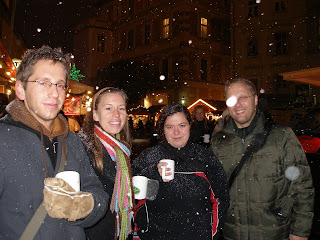
One of the most fabulous Christmas "traditions" I can think of is meeting up with your friends at the Glühwein (mulled wine) stands at the Christmas market. It may be cold, but that nice warm spicy wine makes standing outside super appealing. Here we are with the first Glühwein AND the first snow of the season! (And I love how the snowflake on the right makes my friend look like a pirate!)

The Prettiest Fire Hazard Ever:
Austrians light up their trees with real candles. Sounds scary at first, but it's a beautiful effect, and far less scary if you have a bucket of water nearby. Traditionally, trees don't go up until the 24th--the day Christmas is celebrated in Austria--and don't come down till January 6, or Three Kings Day (Epiphany). It's the Christkind--"Christ Child", or basically a little blond-haired baby angel with wings--who flies in through the window on the afternoon of the 24th when the children are suitable distracted and puts up the tree and leaves the presents. On the way out, the Christkind rings a bell, and the child knows that the Christkind has been there! Time to open presents!

An American Tradition:
I had the good fortune to celebrate Christmas twice this year--once on the 24th, Austrian-style with Austrians, and then again on the morning of the 25th, American-style, with an American friend and her husband. Later that day we again celebrated Austrian-style: going to lunch with family...or an Austrian family, anyway.

Berlin:
What can I say? Berlin was an awesome city. I arrived on the 26th, when it was still in all of its Christmas glory--here you can see just one of the many ferris wheels at the various Christmas markets around the city. I stayed mostly on the East side, but between the tours and museums and history, I was hooked. I've got to go back.
Remnants of the GDR:
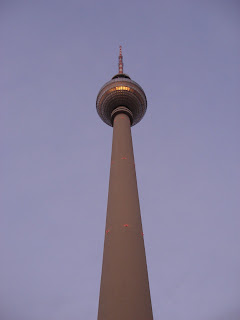
The East German TV tower is just one of the many remants of East Germany's past. It was contructed to boast of East German engineering, but since Berlin makes a city out of swampland, the original tower designed by East German engineers kept sinking. Literally overnight, Swedish engineers were secretly flown in with the expertise necessary to fix the plans, but when they got back, they broke their secrecy agreement. East Germany was embarrassed in the eyes of the West, but thanks to the ever-convenient policy of media censorship, the East Germans were none the wiser and ended up admiring the tower as their own handiwork and beacon to the world. Berlin is chock full of interesting history like this, and I couldn't get enough of it.
The Berlin Wall:
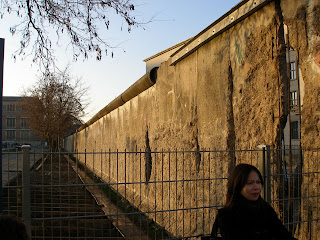
No visit to Berlin would be complete without a visit to the Wall. The history of the wall is intriguing--it literally came up and fell down overnight! It was so fascinating that I bought a book on the subject...and then 4 more books having to do with Berlin as well!

New Year's Eve:
New Year's Eve in Berlin is CRAZY. It's like being in a war zone. The city is crazy wild, with firecrackers and fireworks going off in every street all night long. Everyone is outside partying, and in their festive spirit, sometimes they throw a firecracker on passersby or under cars--one bounced off my leg before exploding! The police watch all of this go down--it's normal. And then some poor city worker is left to clean the streets in the wee hours of the mourn from more debris than I've ever seen in my life.

My Birthday--The Last Holiday of the Holiday Season:
I celebrated my birthday on a Wednesday--a school night--with some close friends in Graz. First stop was Chi-Chi's, our local Austrian Tex-Mex, where I got the closest thing to an "authentic" margarita I could find...and then they brought out this flaming birthday surprise! Oh, and they also let me keep the sombrero. Then we went to my favorite Austrian restaurant where, amazingly, the give you a free 4-course meal on your birthday! Can't argue with that! Then on Friday I had a joint party with a friend who shares my birthday at her spacious apartment on the edge of town. The theme was CREME ACABRIA--an anagram of our names (Rebecca/Maria)--and we encouraged our guests to come in costume, dressed as whatever they interpreted CREME ACABRIA to be. ...There was certainly a lot of coffee represented though...
AND FINALLY......

Holly Golightly and Cotton Ball:
I decided I needed a pet. A pet that offered somewhat cuddly companionship with a short life span...so I got some birthday hamsters. Not just any hamsters though--Dschungarischen Zwerghamster, which, after an inordinate amount of online searching, I discovered are called Winter White Russian Dwarf Hamsters in English. They're the size of mice, but much more adorable and have amazing skills like using a litter box...yes, Austrian hamsters are THAT amazing. They'll probably be getting their own blog entry soon... :)
Subscribe to:
Posts (Atom)